
The Camera
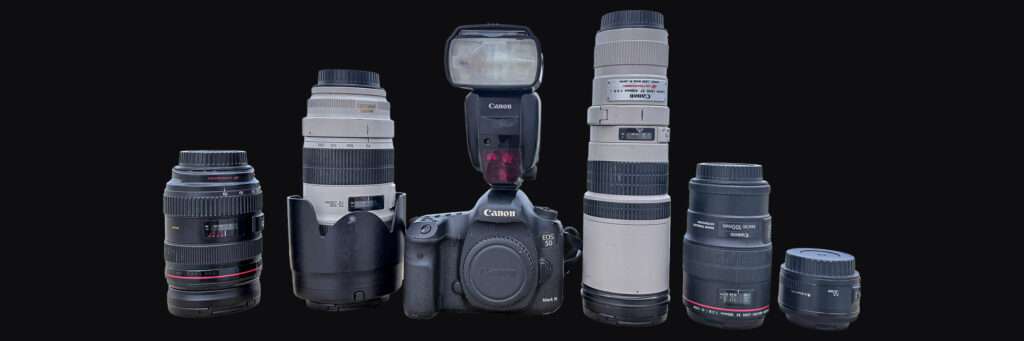
A Canon 5D Mark III. The grip is worn smooth, and the indicators on the mode dial have long since disappeared. I know where each setting is by feel now, which is probably how it should be.
Paired with a Canon 600EX-RT flash and radiant diffuser for macro work, the diffuser softens the light enough that it doesn’t look artificial.
It’s not the newest body on a safari jeep. It doesn’t need to be.
The Lenses
Canon EF 400mm f/5.6L Prime
My wildlife workhorse. No image stabilisation, which keeps you honest. You learn to hold still, pick your moment, and not spray and pray.
Canon EF 70-200mm f/2.8L
The versatile one. Safaris, birds in flight, anything that needs a bit of reach with more flexibility.
Canon EF 50mm f/1.8
Bought it for portraits. Still waiting for the right moment. It’ll happen.
Canon EF 100mm f/2.8L Macro IS
Technically borrowed from a friend years ago. At this point I think we’ve both accepted the situation. This is what I use for everything wild and small – snakes, frogs, spiders, insects. The image stabilisation earns its keep at close focus distances in low light.
The Process
I shoot in RAW and process in Camera RAW/Photoshop. I don’t composite or heavily manipulate, what you see is what was there, adjusted for what my eye saw rather than what the sensor recorded.
For macro work, patience matters more than any piece of gear. Getting low, moving slowly, waiting for the subject to settle. Most good macro frames happen after five minutes of doing nothing.
For wildlife, the 400mm prime taught me to be selective. One sharp frame beats twenty soft ones.